Perhaps no other warehouse has been photographed and sketched so often as has Watts's warehouse. Built in 1858, the people of the day were astonished at the temerity of its owners. (Swindells 18)
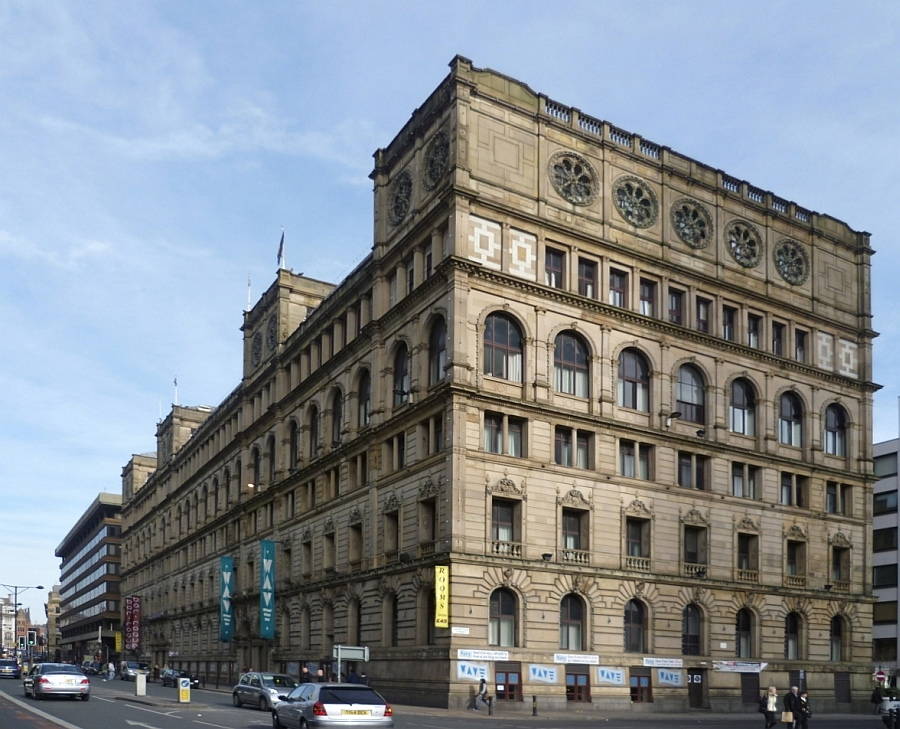
Britannia Hotel (formerly Watts Warehouse), Manchester. Listed Building. Travis & Mangnall. 1851-56. Sandstone ashlar, with granite base (see listing text). Portland Street. As the listing text says, this huge five-storey building, occupying a whole block on this important street, is "the largest and most grandiose of all Manchester warehouses," in an "[e]clectic palazzo style." For example, while the building as a whole is reminiscent of the Fondaco de' Turchi in Venice, which Ruskin enjoyed, each floor is treated in a different way, "from Italian Renaissance to Elizabethan" (for these comparisons, see Hartwell 192), and with Gothic-style wheel windows letting light into the pavilions on the balustraded towers at the top. This last feature marks it as a kind of cathedral to commerce. 100' high, 300' long and 90' deep (Parkinson-Bailey 78), it is indeed massive, with twenty-three bays along Portland Street, and seven bays at each end, the proud flagship of the biggest wholesale drapers' in this then rapidly expanding, flourishing northern town.


Left: Wheel windows on the end roof tower return, matching the two on front of each tower on the Portland Street elevation (see main picture). Right: Keystone with ship's prow, above the ground floor windows.. On the tower, notice also the parapet with balustrade, and the strapwork picked out in white. According to Clare Hartwell, there were originally gables "between and on top of the towers" as well (192), which must have made it look even more ornate. Above the first storey windows, the ships' prows on the keystones alternate with herms bearing baskets of produce (see below), all very suitable since the owner, James Watts (1804-1878, twice Mayor of Manchester and knighted in 1857), was a self-made man and supporter of free trade (see Swindells 270). Watts used Travis & Mangnall for work on his home, Abney Hall in Cheshire, as well — where Pugin designed or inspired the work carried out on the interior by J. G. Crace (see Hill 418). Watts was evidently a man who wanted only the very best, and the most sumptuous, that the age could offer


Left to right: (a) One of the herms. (b) The elaborate entrance. Note the different keystone masks above, carving down the sides, and steps into the interior. (c) Main staircase.
The glory of the interior is this wonderfully impressive main staircase, with elaborate cast-iron balustrades and pillars. The listing text describes the staircase as having "flying lateral flights at each floor in the form of a succession of 'Ponte Rialtos.'"


Left to right: (a) Side view of the staircase. (b) One of the landings. (c) Lower, semi-basement area.
Hartwell writes that "[t]he building had four large internal wells and a system of circulation which segregated customers, staff and porters" (192). With the five main floors above, perhaps customers never found their way down to this lower level, where stout iron columns proclaim the solid industrial base of Watts's enterprise. Now of course this part seems attractively atmospheric. On the three acres of floor in the building, there were 600 staff, selling wholesale goods — everything from umbrellas to corsets — in what was not just the biggest but "by far the biggest" building in the town when completed (Parkinson-Bailey 79). Partly because of its sheer size, it still makes an enormous impact in which the variety of elements involved all play a part. Nothing could better encapsulate the drive, vision and confidence of this era in the town's history, except perhaps the majestic town hall that was yet to be built.
The 1988 Philip Saville film The Fruit Machine featured interior and main entrance scenes of the Adelphi Hotel in Liverpool, including a vertical pan shot past the lit marquee at night.[citation needed]
Soon after its foundation, Britannia began making a number of further acquisitions. The second purchase in 1981 was a derelict listed building in central Manchester (the former Watts Warehouse standing on Portland Street). After redeveloping the unit it opened in May 1982 as the Britannia Hotel Manchester. At the end of 1982, British Rail sold off its hotel division, British Transport Hotels. From this sale, in 1983 Britannia bought the Britannia Adelphi Hotel in Liverpool.
In 1987 Britannia Hotels converted an unused building in Manchester that had been the city's C&A department store - this became the Sachas Hotel.[13][14]Later in the same year Bosworth Hall, a country house style hotel in Market Bosworth, Leicestershire, was purchased. Bosworth Hall was being converted from a hospital/nursing home into a hotel and Britannia took over the development from the builders who went bankrupt. In 1988 the company purchased and began development of the International Hotel adjacent to Canary Wharf in London. The hotel opened on 9 June 1992. A year later, Britannia took over a 187-bedroom hotel in Stockport. After a period of refurbishment, the Britannia Stockport Hotel opened in 1993. In the summer of the same year, the group also purchased the Europa Hotel situated close to Gatwick Airport

No comments:
Post a Comment